Is Paper-Based IELTS Discontinued? What Replaced It in 2026
Yes. Paper-based IELTS has been discontinued. The IELTS partners announced in March 2026 that IELTS would no longer be offered as a paper-based test from mid-2026, and in India the final paper-based test was held on 22 August 2026. Since September 2026, every IELTS test in India is delivered on a computer.
So if you came here asking whether to choose paper or computer, the question has been settled for you. What you do still choose is how you write, and that choice is worth thinking about properly.
Let me take you through what actually happened, what it changes, and what it does not.
What the IELTS partners announced
In March 2026, the three organisations that jointly own IELTS, the British Council, IDP Education and Cambridge University Press & Assessment, published a joint statement. The key line was:
"After careful review, from mid-2026, we will no longer offer IELTS as a paper-based test. All IELTS tests will be delivered on computer. Exact timelines will vary by market."
Their stated reason was test taker satisfaction. Candidates who took IELTS on computer reported a better experience: faster results, more available dates, and access to One Skill Retake, which has only ever been available on the computer version.
Two things accompanied the announcement. A new Writing on Paper option for selected markets, which I come to below. And confirmation that access arrangements continue unchanged, including large print, braille and lip-reading provision for hearing-impaired candidates.
What happened in India
India's timetable was confirmed by IDP, which has delivered every IELTS test in the country since 2021.
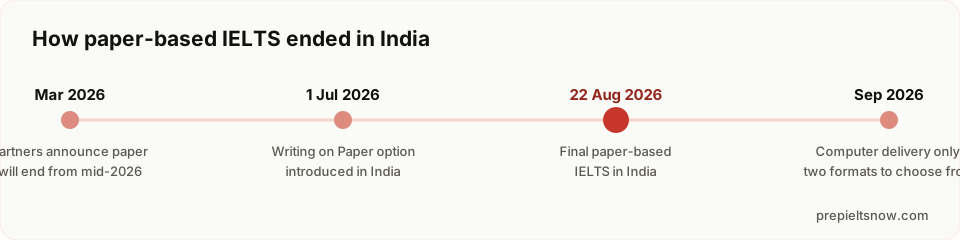
| Date | What happened |
|---|---|
| March 2026 | Global announcement: paper-based IELTS to end from mid-2026 |
| 1 July 2026 | IELTS on Computer (Writing on Paper) introduced in India |
| 16 July 2026 | IDP confirms India's full transition timetable |
| 25 July 2026 | Paper-based test date |
| 6 August 2026 | Paper-based test date |
| 22 August 2026 | Final paper-based IELTS in India |
| September 2026 onwards | Computer delivery only |
After 22 August 2026, paper-based IELTS is not available anywhere in India.
Does this affect a result you already have?
No. All existing paper-based IELTS results remain fully valid for the standard two-year period from your test date.
Nothing about your Test Report Form changes, nothing needs resubmitting, and no institution treats a paper-based result differently. If you took IELTS on paper in 2025 or early 2026, your score is exactly as usable as it was the day it was issued.
Your two options now
Since September 2026, you choose between these when booking.
| IELTS on Computer | IELTS on Computer (Writing on Paper) | |
|---|---|---|
| Listening | On screen | On screen |
| Reading | On screen | On screen |
| Writing | Typed on screen | Handwritten on paper |
| Speaking | Face to face with an examiner | Face to face with an examiner |
| Question types | Identical | Identical |
| Difficulty and scoring | Identical | Identical |
| Results | 1 to 2 days | 1 to 2 days |
| One Skill Retake available | Yes | Yes |
That is the whole difference. One section, one input method.
In the Writing on Paper version, the questions appear on screen and you write your answers by hand in a paper answer booklet. Research by the IELTS partners found that scores from handwritten and typed Writing are comparable, which is the whole basis for offering both.
Which of the two should you choose?
A real decision, with real consequences, so think about it rather than defaulting.
Choose IELTS on Computer (fully typed) if:
You type reasonably comfortably. You do not need to be fast. You need to be able to type without thinking about typing.
You like to revise as you write. This is the strongest argument. On screen you can insert a sentence into paragraph two after writing paragraph four, reorder your points, and fix a word choice without a mess. On paper, restructuring means crossing out.
You want the live word count. Under 150 or 250 words is penalised, and on paper you are counting by hand with the clock running. On screen the number is just there.
Your handwriting is difficult to read. Examiners mark what they can read. Illegible handwriting costs marks that typing would not.
Choose Writing on Paper if:
You genuinely plan better with a pen. Some people cannot structure an argument on screen. If that is you, it is not a weakness to fix in three weeks before a test.
Your typing is slow enough to eat your time. Forty minutes for Task 2 is not generous. If typing costs you ten of those minutes, you are handing away a paragraph.
You have practised entirely on paper and your test is soon. Changing input method a fortnight before test day is not the moment to experiment.
The honest default
For most candidates with a few weeks to prepare, fully computer-delivered is the better choice, because editing on screen is a real advantage in a timed essay and the word count removes an entire category of error.
But if you have tried both and your writing is visibly better by hand, take the hybrid. The scores are comparable. The formats exist so you can pick the one that lets you perform.
What has not changed
This is the part worth emphasising, because the announcement unsettled a lot of students who assumed the test itself had been redesigned. It has not.
- The same four skills, Listening, Reading, Writing, Speaking
- The same timings: Listening around 30 minutes, Reading 60, Writing 60, Speaking 11 to 14
- The same 40 questions in Listening and Reading
- The same question types across every section
- The same 0 to 9 band scale and the same marking criteria
- The same face to face Speaking test with a human examiner
- The same two-year validity
- The same recognition by universities, employers and immigration authorities
- The same fee
- The same Academic and General Training versions
One genuine change inside the test: on computer, there is no ten minute transfer time at the end of Listening, because there are no answers to copy onto an answer sheet. You get a shorter review period instead. Any preparation guide still telling you about transfer time was written for a test that no longer exists.
What this means for your preparation
The format change has one real consequence, and students underestimate it.
Practise on a screen. Reading a 900 word passage in a scrolling window, with questions beside it, is a different physical experience from reading it on paper. You cannot spread three pages out. You cannot underline with a pencil. You scroll, and scrolling makes it easier to lose your place.
If your practice has been printed PDFs and workbooks, you have been rehearsing a test that no longer exists. Move your timed practice onto a screen now, with headphones, a clock and no pausing.
If you chose fully typed, write your practice essays by typing them, in 40 minutes, without spellcheck. Your typing will not be the problem. Your planning on screen might be.
If you chose Writing on Paper, keep handwriting your essays, but do your Listening and Reading on screen, because those sections are on screen either way.
Common questions
Is paper-based IELTS completely discontinued? Yes. IELTS stopped offering paper-based tests from mid-2026, with 22 August 2026 as the final date in India.
Which is better, computer or paper based IELTS? Paper is no longer offered, so the choice is between IELTS on Computer and IELTS on Computer (Writing on Paper). Typed suits most people, because of on-screen editing and the live word count.
Is computer-delivered IELTS harder? No. Same questions, same difficulty, same scoring. What differs is the physical experience, which is why practising on screen matters.
Is my paper-based result still valid? Yes, for the full two years from your test date.
Can I still handwrite my Writing answers? Yes, by choosing IELTS on Computer (Writing on Paper). Listening and Reading are still on screen.
Does typing speed affect my Writing score? Not directly. Typing is not a marking criterion. But slow typing eats the time you need for planning and checking, which does affect your score.
Is the Speaking test done on a computer now? No. Speaking remains a face to face conversation with a certified examiner. Only the Listening, Reading and Writing delivery changed.
Is IELTS UKVI also computer only? Yes. UKVI tests moved to computer-only delivery worldwide from March 2026.
Are results faster now? Yes. Computer-delivered results in India typically arrive within one to two days, compared with up to 13 days for paper.
The practical takeaway
The decision has been made for you, and on balance it favours you: more test dates, faster results, and access to One Skill Retake if one section lets you down.
What you have to do is adapt your practice. Get your timed work onto a screen this week. That single change matters far more than the announcement itself.
Read next
Want your real band score, not just tips?
Take a full practice test in an interface identical to the real Computer-Delivered IELTS exam, free.
Sign Up Free →

