What Is Computer-Delivered IELTS? The Screen, Rules and Timing

Computer-delivered IELTS is the standard IELTS test taken at an official test centre, with the Listening, Reading and Writing sections completed on a desktop computer instead of on paper. The Speaking test is still face to face with a human examiner. Since September 2026, this is the only way to take IELTS in India, after paper-based testing was withdrawn worldwide from mid-2026.
The questions, the timings, the difficulty and the band scale are identical to the paper test it replaced. What changed is the physical experience, and since that is what you will actually be sitting in front of, let me describe it properly.
Is it online or offline?
Neither word fits well, and the confusion causes real problems, so let me separate three things that get muddled constantly.
IELTS on Computer is taken at a test centre, on the centre's computer, under supervision, with a face to face Speaking test. It is not taken at home. People sometimes call this "online IELTS", which is where the trouble starts.
IELTS Online is a different product entirely. It is IELTS Academic taken at your home on your own computer, supervised remotely, with Speaking by video call. It is not accepted for visa or immigration purposes anywhere.
IELTS on Computer (Writing on Paper) is the hybrid: Listening and Reading on screen at the centre, Writing handwritten on paper, Speaking face to face.
If your application is for a visa, you need one of the test centre options, not IELTS Online. Booking the wrong one means paying twice, and I have seen it happen more than once.
What the room and the screen look like
You sit at a desktop computer in a room of other candidates, with headphones, a keyboard and a mouse. An invigilator is present throughout and the session starts for everyone at the same moment.
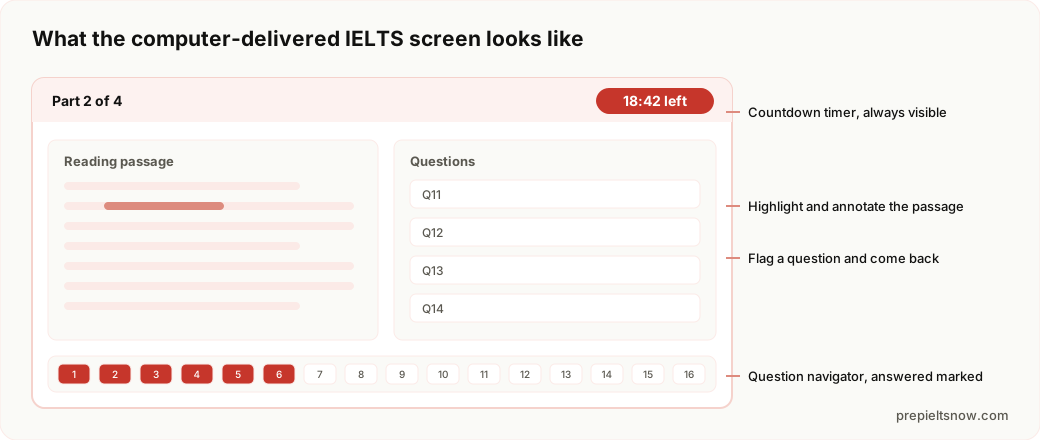
The computer-delivered IELTS interface, with the tools most candidates forget to use.
The interface is deliberately plain. No animations, no distractions.
A split screen. The reading passage or listening questions on one side, your answer area on the other.
A countdown timer in the corner, always visible, showing how much time is left in the current section. Many candidates find this more reassuring than a wall clock, because there is no mental arithmetic to do.
Question navigation at the bottom, showing all 40 questions with the answered ones marked. You can jump to any question.
A flag or review function, letting you mark a question to come back to.
Text highlighting and note taking in Reading, so you can mark parts of the passage on screen, as you would with a pencil.
A live word count in Writing, which removes an entire category of anxiety.
Adjustable font size and volume, set at the start.
You are also given paper or a small whiteboard for rough notes, which is collected at the end. So yes, you can plan your essay by hand even on the fully typed version.
Section by section, on screen
Listening, around 30 minutes
Four recordings, each played once. The audio comes through your headphones, not through a room speaker, which means you control the volume and you are not affected by where you are sitting. This is a genuine improvement over the paper test.
Questions appear on screen alongside the audio, and you type or click your answers as you listen.
One real change from the paper test: there is no ten minute transfer time at the end. On paper, candidates copied their answers from the question booklet onto an answer sheet, and that is what the ten minutes was for. Your answers are already recorded on screen, so there is nothing to transfer. You get a shorter review period instead.
Any preparation guide still telling you about ten minutes of transfer time was written for a test that no longer exists. Plan your Listening pacing accordingly.
Reading, 60 minutes
Three passages, 40 questions, no extra time at the end.
The passage sits on one side of the screen and you scroll through it. Question types are the same as always: matching headings, true/false/not given, multiple choice, sentence completion and the rest.
You can highlight text and add notes directly on the passage. Most students who have practised on screen use this heavily, and most who have not practised forget it exists.
The honest difficulty here is scrolling. On paper you could spread three pages across a desk and see the shape of the text. On screen you see one window at a time, and it is easier to lose your place in a long passage. That is a skill, and it is built by practice, not by willpower on the day.
Writing, 60 minutes
Two tasks. Task 1 at least 150 words, Task 2 at least 250, with Task 2 worth twice the marks.
You type into a plain text box with a live word count. Backspace, delete, cut, copy and paste all work normally, which means you can restructure a paragraph without crossing anything out.
There is no spellcheck and no grammar check. This surprises people who have only ever written in a word processor. Spelling and grammar are part of what is being assessed, so the software does not help you.
Does backspace count towards the word count? No. The count reflects what is currently in the box. Deleted text is simply gone.
If you booked Writing on Paper, this is the only section that differs: the questions appear on screen and you handwrite your answers in a paper booklet.
Speaking, 11 to 14 minutes
Unchanged. A face to face interview with a certified IELTS examiner in a separate room, in three parts, recorded for quality assurance.
No computer involved. No chatbot, no AI assessment, no recorded prompts. A real person, asking real follow-up questions.
How long does the whole thing take?
Listening, Reading and Writing run back to back with no break, totalling roughly 2 hours 45 minutes.
Add arrival and security, which takes about an hour, and Speaking if it is on the same day. Plan for four to five hours at the centre.
What you can and cannot do
You can: - Take notes on provided paper or a whiteboard - Highlight and annotate text on screen in Reading - Flag questions to revisit - Navigate freely between questions within a section - Adjust volume and font size - Edit your Writing freely
You cannot: - Pause, rewind or replay the Listening audio - Go back to a section once its time is up - Use spellcheck or any writing aid - Bring in your own headphones, notes, phone or watch - Take your rough notes out of the room
What is actually better, and what is harder
I think it is worth being even-handed about this rather than selling the format.
Better: results in one to two days rather than up to thirteen. Far more test dates. Your own headphones-level audio control. A live word count. Editing without mess. Access to One Skill Retake, which has only ever existed on computer. No handwriting legibility risk.
Harder: scrolling through long passages instead of seeing a whole page. Reading on screen for sixty minutes is more tiring for some people. If you type slowly, Writing is tighter than it was. And there is no transfer time at the end of Listening to tidy up with.
None of these are reasons to be anxious. They are reasons to practise on the thing you will actually sit.
Common questions
Is computer-delivered IELTS the same test? Yes. Same questions types, same timings, same difficulty, same band scale, same marking criteria.
Is IELTS online or offline? IELTS on Computer is taken at a test centre, in person. IELTS Online is a separate product taken at home, not accepted for visas.
Can I take notes during computer-delivered IELTS? Yes. Paper or a whiteboard is provided, and collected afterwards.
Do I get rough paper for the computer-based test? Yes, provided by the centre.
Does backspace count in the word count? No. The word count reflects what is currently written.
Is there spellcheck? No. Spelling and grammar are assessed, so no writing aids are available.
Do I get headphones? Yes, provided by the centre, with volume you can adjust at the start.
Can I replay the Listening audio? No. Each recording plays once.
Is the Speaking test on a computer? No. It is face to face with a certified human examiner.
How long is the computer-delivered test? About 2 hours 45 minutes for Listening, Reading and Writing, plus 11 to 14 minutes for Speaking.
Is typing speed important? Not as a marking criterion, but slow typing eats into the time you need for planning and checking in Writing.
What to do next
Everything above describes an experience you can rehearse before test day, and rehearsing it is the whole point.
Do your next full practice test on a screen: headphones on, timer running, no pausing the audio, no spellcheck in Writing, and rough notes on actual paper beside you. The first time you do it will feel awkward. By the third time it will feel like nothing, and that is exactly the state you want to walk into the centre in.
Read next
Want your real band score, not just tips?
Take a full practice test in an interface identical to the real Computer-Delivered IELTS exam, free.
Sign Up Free →