How to Prepare for IELTS at Home: A Self-Study Plan That Works
You can absolutely prepare for IELTS at home without coaching. Sit one full timed test to find your real starting band, spend most of your time on your weakest skill, do a complete timed test on screen every week, and speak English out loud every day. Most candidates who are within a band of their target get there in six to eight weeks of honest work.
I have taught both classroom students and self-preparing ones, and the self-preparing ones often do better. Not because coaching is useless, but because people who prepare alone tend to be the ones who actually sit the practice tests. Attendance is not progress.
Here is how to do it properly.
Start with a number, not a plan
Before you make a schedule, before you buy anything, before you watch a single video, sit one complete IELTS practice test under real conditions.
That means on a screen, headphones on, timer running, the Listening audio never paused, sixty minutes for Reading with no extensions, sixty minutes for Writing, no dictionary, no breaks between sections.
Then mark your Listening and Reading honestly against the answer key.
Whatever comes out is your starting band. It is probably lower than you hoped, and that is useful information rather than bad news. Every decision after this depends on it.
| Gap to your target | Realistic preparation time |
|---|---|
| 0.5 band | 3 to 4 weeks |
| 1 band | 6 to 8 weeks |
| 1.5 bands | About 3 months |
| 2 bands or more | 4 to 6 months |
Students skip this step because it is uncomfortable. Then they book a test for next month based on nothing, and pay nineteen thousand rupees to receive the number they could have had for free.
Spend one hour learning what the test rewards
This is the highest value hour in your whole preparation, and almost nobody does it.
Read the public band descriptors for Writing and Speaking. They are published, they are free, and they tell you precisely what examiners are instructed to look for at each band.
You will discover that Writing is marked on four criteria of equal weight:
- Task achievement (Task 1) or task response (Task 2)
- Coherence and cohesion
- Lexical resource
- Grammatical range and accuracy
Only one of those is vocabulary. Yet when I ask students what they are doing to improve their Writing, nine out of ten say "learning new words". They are optimising a quarter of the mark and ignoring the rest.
Speaking works the same way: fluency and coherence, lexical resource, grammatical range and accuracy, and pronunciation. Again, one quarter is vocabulary.
Read the descriptors for your target band and the one below it. The difference between those two descriptions is your actual to-do list.
Set up your practice environment
Since September 2026, every IELTS in India is computer-delivered, after paper-based testing ended on 22 August 2026. So your practice has to happen where the test happens, which is on a screen.
Your setup:
- A laptop or desktop, not a phone
- Headphones for every Listening practice
- A visible countdown timer
- Paper and a pen beside you for rough notes, as provided at the centre
- Spellcheck and autocorrect switched off, because there is none in the test
- A desk, not a bed
If you have been working through printed books and PDFs, keep them for learning question types, but move every timed practice onto a screen. Reading a long passage in a scrolling window is a genuinely different skill, and test day is a poor time to find that out.
A realistic eight week plan
This assumes ten to twelve hours a week. Scale it to your life, but keep the shape.
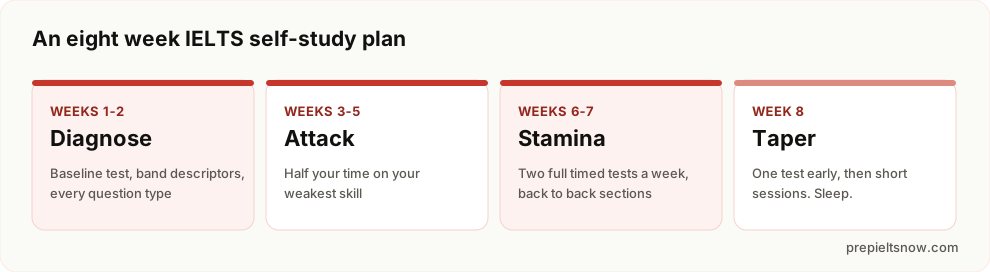
Weeks 1 to 2: diagnose and learn the rules
- One full timed test in week 1 to establish your baseline
- Read the band descriptors for Writing and Speaking
- Learn every question type in Listening and Reading, including the ones you have been avoiding. Most students have drilled four or five types repeatedly and never once attempted matching headings or a process diagram
- Write one Task 1 and one Task 2 under timing, then compare them honestly against the descriptors
- Speak out loud for ten minutes daily
Weeks 3 to 5: attack your weakest skill
This is where the band actually moves. Give your weakest skill roughly half your total study time.
- Daily: one Listening section with headphones, no pausing
- Daily: one Reading passage in twenty minutes, on screen
- Three times a week: one full Writing task under time
- Daily: ten to fifteen minutes speaking out loud
- Weekly: one full timed test
Weeks 6 to 7: build stamina and pace
- Two full timed tests a week, all sections back to back with no break
- Review every wrong answer and write down why it was wrong, not just what the right answer was
- Keep a running list of words you misspell. It will be shorter and more repetitive than you expect
- Record your Speaking and listen back
Week 8: taper
- One full test early in the week
- Short, sharp sessions after that
- Stop doing full tests two days before the exam
- Review your spelling list, your essay structures and your Part 2 practice
- Sleep properly
Skill by skill: what actually works
Listening
Never pause the audio. Not once. It is the most common self-study habit and the most damaging, because the test never pauses and you are training a reflex you will not be allowed to use.
Read ahead. Answers come in the same order as the recording, so train yourself to be scanning the next question while the current answer is still being spoken.
Practise recovery. When you miss one, drop it instantly and lock onto the next. Candidates lose three answers chasing one.
Vary your accents. British, Australian, New Zealand, Canadian, American. If all your listening practice is one accent, you are exposed. Podcasts, documentaries and news from different countries all count.
Fix your spelling. A correct answer spelled wrongly scores zero. This is the cheapest half band you will ever find.
Reading
Twenty minutes per passage, enforced. Set a timer for each. Move when it goes, even mid-question. Passage 3 is the hardest, and arriving there with six minutes left is how good readers end up with a 6.
Skim first, then scan. Skim for the shape of the text and the topic of each paragraph. Then scan for the specific thing each question asks about. Reading every word once, carefully, is the slowest possible method and the one most students default to.
Master True / False / Not Given. It is the most commonly failed question type, always for the same reason: candidates use their own knowledge. Not Given does not mean false. It means the passage does not say. If you are reasoning about the real world rather than about the text, you have already gone wrong.
Use the on-screen highlight tool. It exists, it replaces the pencil underlining you used to do, and students who never practised with it forget it is there.
Writing
Learn the four criteria first. Everything below assumes you have.
Answer the whole question. Task response is a full quarter of the mark, and it is where most candidates lose their half band. If the question says "discuss both views and give your opinion", you need both views and your opinion. Two out of three caps your band no matter how good the English is.
Plan for five minutes. It feels like lost time. It is not. An unplanned essay wanders, and coherence and cohesion is another quarter of the mark.
Twenty minutes on Task 1, forty on Task 2. Task 2 is worth twice as much. Practise with two timers until the split is automatic.
Write fewer essays and review them properly. Ten essays you have analysed against the descriptors beat forty you have only written. If you cannot get feedback, leave an essay for three days and then mark it yourself against the band descriptors. You will find more than you expect.
Do not memorise templates. Examiners recognise them immediately and they are penalised under task response. Learn structures, which flex, not scripts, which do not.
Speaking
This is the skill self-preparers neglect, because it is the only one you cannot do silently.
Speak out loud every single day. Ten minutes beats an hour of watching videos about speaking.
Record yourself and listen back. Uncomfortable the first three times and useful every time after. You will hear your own fillers, your repeated structures and the places you trail off.
Practise Part 2 properly. One minute to plan, then talk for a full two minutes without stopping. Time it. Most people stop at forty seconds the first few times, and a short answer is very hard to score well.
Prepare Part 3 thinking, not Part 3 answers. Part 3 asks you to compare, speculate and justify. Practise the moves: "on the one hand", "it depends on", "in my experience", "I would imagine that". These are habits, not scripts.
Find a partner if you possibly can. A real listener asks real follow-up questions, and Part 3 is made of follow-up questions. If you cannot, speak to your recorder and then answer your own follow-ups.
What does not work
I want to name these, because they are popular, they feel productive, and they move nothing.
Memorising long word lists. Vocabulary learned in isolation does not transfer into speech or writing under pressure. Words learned in context do.
Memorising model essays. Penalised, recognisable, and useless the moment the question is slightly different from the one you learned.
Watching preparation videos without practising. Comfortable, passive, and it feels like studying. Two hours of video is worth less than one timed Reading passage.
Practising untimed. The test is largely about pace. Untimed practice trains the wrong thing.
Doing only your strongest skill. It is more enjoyable to practise what you are already good at. It will not raise your overall band.
Changing method every week. Pick an approach and give it three weeks before you judge it.
Can you prepare for free?
Mostly, yes.
Free and worth using: official familiarisation and practice tests, the published band descriptors, official sample questions and answers, English podcasts and news from varied accents, and anything you read in English daily.
Worth paying for, if anything: feedback on your Writing and Speaking. This is the one thing you genuinely cannot do alone, because you cannot see your own blind spots. If your budget stretches to one thing, make it this rather than a general course.
Not worth paying for: vocabulary lists, question banks you will not finish, and anything promising a guaranteed band score. Nobody can promise a band score.
What you do need is volume of full timed practice on a screen, because that is what builds pace, and pace is what most people are actually missing. Prep IELTS Now exists for that: full-length computer-delivered practice tests you can sit under real conditions, as many times as it takes for the rhythm of the test to stop feeling like an event.
How to know you are ready
Three signals, and you want all three before you book.
You are consistently hitting your target in full timed practice tests, not in your best single attempt. Practice scores swing half a band either way, so you want your target to be your average rather than your ceiling.
Your weakest skill is at or above the minimum your institution requires. Overall scores hide a weak section until the admissions office finds it.
The pace no longer feels like an attack. Reading finishes on time. Listening does not panic you. Task 2 gets written and checked.
When all three are true, book. When they are not, move the date.
Your first week, concretely
Today: sit one full timed test on a screen and find your real band.
Tomorrow: read the Writing and Speaking band descriptors for your target band and the one below it.
The rest of the week: one Listening section daily with headphones and no pausing, one Reading passage in twenty minutes, one timed Writing task, and ten minutes of speaking out loud every day.
That is a week of real preparation, it costs nothing, and it will tell you more about your chances than any amount of reading about how to prepare.
Read next
Want your real band score, not just tips?
Take a full practice test in an interface identical to the real Computer-Delivered IELTS exam, free.
Sign Up Free →

