What Is IELTS? Full Form, Meaning and Who Actually Needs It
IELTS stands for the International English Language Testing System. It is an English language test that measures how well you can listen, read, write and speak in English, and it reports your ability as a band score from 0 to 9. Universities, employers and immigration departments in countries like the UK, Australia, Canada, New Zealand and the US use that score to decide whether your English is strong enough for what you are applying to do.
That is the short version. If you have ten more minutes, let me give you the version I give my students in their first class, because the full form is the least useful thing to know about this test.
What does IELTS actually measure?
Here is the first thing worth getting straight: IELTS is not an English grammar exam.
I say this because most students arrive expecting a paper full of fill in the blanks and tense corrections. There are none. There is no section where you label parts of speech. Nobody asks you to define a word.
Instead, IELTS puts you in four situations and watches how you cope:
- Listening. You hear real conversations and talks, each played once, and answer questions as you go.
- Reading. You get long passages and limited time, so you have to find information fast rather than read every word.
- Writing. You produce two pieces of writing with a clear purpose and a word count.
- Speaking. You sit with a trained examiner and talk for 11 to 14 minutes about yourself, then about a topic you have never seen before.
The test is asking one question in four different ways: can this person function in English when the pressure is on? Your grammar matters, but only because weak grammar gets in the way of being understood. A student with perfect textbook grammar who freezes when an Australian accent comes through the headphones will score lower than a student with a few errors who keeps up.
That shift in thinking is usually what moves a band score more than anything else.
What does the IELTS score mean?
IELTS does not have a pass or fail. You get a band score between 0 and 9, and the organisation you are applying to decides what counts as good enough.
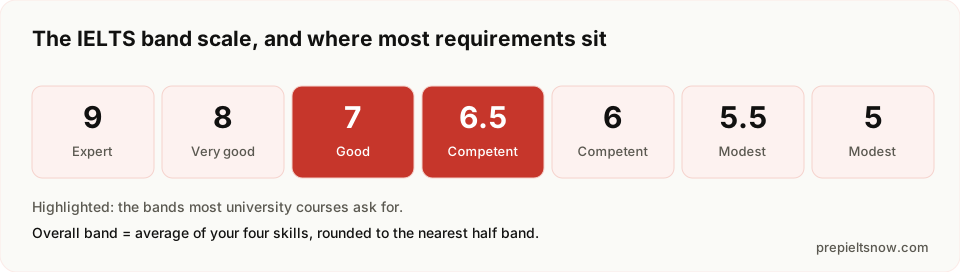
| Band | What it means | Typical use |
|---|---|---|
| 9 | Expert user | Rarely required |
| 8 | Very good user | Competitive universities, some PR routes |
| 7 | Good user | Most postgraduate courses, many skilled visas |
| 6.5 | Competent user, upper end | The most common university requirement |
| 6 | Competent user | Many undergraduate courses, some visas |
| 5.5 | Modest user | Foundation and pathway programmes |
| 5 and below | Modest to limited | Usually below requirement |
You receive five scores in total: one for each of the four skills, plus an overall band score, which is the average of the four rounded to the nearest half band.
Two things trip people up here.
First, the rounding. If your four scores average out to 6.625, that rounds up to 6.5, not 7. Averages ending in .25 go up to the next half band, and averages ending in .75 go up to the next whole band. Run your own numbers before you assume you are safe.
Second, the minimum per section rule. A university may ask for an overall 6.5 with no band below 6. You can hit the overall figure and still be rejected because your Writing came in at 5.5. Check the small print on your course page before you decide which skill to work on.
Who needs to take IELTS?
You probably need it if you fall into one of these groups.
Students. You are applying to a university abroad where teaching is in English, and the course page lists an English language requirement. This is the biggest group by far.
People applying for a visa. Several immigration systems award points for English ability or set a minimum level. Australia, New Zealand and Canada all work this way. The UK has its own rule, explained below.
Professionals. Nurses, doctors, engineers and teachers often need to prove English to a registration body before they can work, and those bodies frequently name a specific band per skill.
People who just want proof. Some candidates take IELTS to have a recognised certificate for a job application at home. It is a smaller group, but it exists.
If none of this describes you, you may not need the test at all. I have had students book an exam because a friend told them to, then discover their chosen university accepts their medium of instruction certificate instead. Read the requirement page first. It costs nothing and it might save you nineteen thousand rupees.
Is IELTS one test or several?
Several, and picking the wrong one is an expensive mistake that nobody at the test centre will catch for you.
IELTS Academic is for higher education and for professional registration. The Reading passages come from books, journals and newspapers, and Writing Task 1 asks you to describe a graph, chart, map or process.
IELTS General Training is for migration, work experience and below degree level study. The Reading is built from notices, advertisements, handbooks and company documents, and Writing Task 1 is a letter.
IELTS for UKVI is the same test content, taken at a centre approved by the UK Home Office, with extra identity checks. If your application goes to the UK Home Office, this is the version you need. A standard IELTS result will not be accepted for a UK visa, even if the score is identical.
IELTS Life Skills is a short speaking and listening only test at A1, A2 or B1 level, used for certain UK family and settlement routes. No reading, no writing, no band score.
IELTS Online is IELTS Academic taken at home under remote supervision. Useful for some university applications, accepted by no immigration authority.
The content, the marking and the band scale are identical across Academic and General Training. Only the Reading passages and Writing Task 1 differ.
How do you take IELTS now that paper tests have ended?
This is the part where most of the information online is out of date, so read carefully.
In March 2026, the IELTS partners announced that paper-based IELTS would be withdrawn worldwide from mid-2026. In India, IDP confirmed the timetable in July: the final paper-based test was held on 22 August 2026, and from September 2026 every IELTS in the country is delivered on a computer.
You now choose between two versions:
- IELTS on Computer. Listening, Reading and Writing on screen. Speaking stays face to face with a certified examiner.
- IELTS on Computer (Writing on Paper). Listening and Reading on screen, Writing handwritten on paper, Speaking still face to face.
Everything that matters stayed the same. Same four skills, same question types, same timings, same 0 to 9 band scale, same two year validity, same human examiner in the Speaking room. If you took a paper test before August 2026, your result is still valid for the full two years.
One practical consequence: if you choose full IELTS on Computer, your typing is now part of your Writing performance. Not your speed alone, but your comfort. Students who have only ever practised on paper tend to lose five minutes to the unfamiliar screen, and five minutes in Task 2 is a paragraph.
What does IELTS cost and how long is it valid?
In India the standard fee for IELTS Academic and General Training rose to ₹19,000 on 1 April 2026. IELTS for UKVI sits slightly higher, and IELTS Life Skills slightly lower. Fees change, so confirm the current figure on the official booking site before you budget.
Your result is recommended as valid for two years from the test date. That is not a legal expiry so much as a standard the receiving institutions apply, and almost all of them apply it strictly. Time your test so the score is still fresh when your application is assessed, not when you sit the exam.
Who runs IELTS?
IELTS is jointly owned by three organisations: the British Council, IDP Education and Cambridge University Press & Assessment. They write the test together, and they share one marking standard.
In India, though, there is only one place to book. The British Council sold its India IELTS business to IDP in 2021, and since 25 July 2021 IDP has delivered every IELTS test in India. If a website or an agent offers you a British Council IELTS slot in India, something is wrong with that offer.
Which organisation marks your test makes no difference to your score anywhere in the world. The marking criteria are identical, examiners are trained to the same standard, and the tests are monitored for consistency. The idea that one provider "scores easier" is the most persistent myth in IELTS preparation, and it has never been true.
Is IELTS hard?
It is a fair test rather than a hard one, and the difference matters.
Nothing in IELTS is designed to trick you. The questions follow the recording or the passage in order. The Writing tasks tell you exactly what to cover. The Speaking examiner is not trying to catch you out, and will not react to your opinions.
What makes IELTS feel hard is the pace. The Listening recording plays once. The Reading gives you sixty minutes for forty questions across three long passages. In Speaking Part 2, you get one minute to plan and then you talk alone for two.
None of that improves by learning more vocabulary. It improves by doing full tests under real timing until the pace stops feeling like an attack. Most students who plateau at 6.5 are not short of English. They are short of practice under the clock.
Common questions about IELTS
What is the full form of IELTS? International English Language Testing System.
Is IELTS a British or Australian test? Neither, exactly. It is jointly owned by the British Council, IDP Education (Australia) and Cambridge University Press & Assessment (UK). It accepts all standard varieties of English, so British, American, Australian and Indian spellings and accents are all fine, as long as you are consistent.
Can you fail IELTS? No. There is no pass mark. You receive a band score, and the organisation you are applying to decides whether it is high enough.
How long does the test take? About 2 hours 45 minutes for Listening, Reading and Writing, which run back to back with no break. Speaking is 11 to 14 minutes and may be on the same day or within a few days.
Is IELTS accepted everywhere? It is accepted by more than 12,000 organisations worldwide, including universities, employers, professional bodies and governments. Always check your specific institution, and check whether they need the Academic, General Training or UKVI version.
How many times can I take it? As many times as you want. There is no limit and no waiting period, though you pay the full fee each time. If you only need to fix one skill, look at One Skill Retake instead.
Where to go from here
If you are at the very start, do these three things in order. Find your target institution's exact requirement, including any minimum per section. Decide whether you need Academic, General Training or UKVI. Then sit one full practice test under real conditions, before you book anything, so you know how far you actually have to travel.
That last step is the one students skip, and it is the one that tells you whether you need three weeks or three months.
Read next
Want your real band score, not just tips?
Take a full practice test in an interface identical to the real Computer-Delivered IELTS exam, free.
Sign Up Free →

